
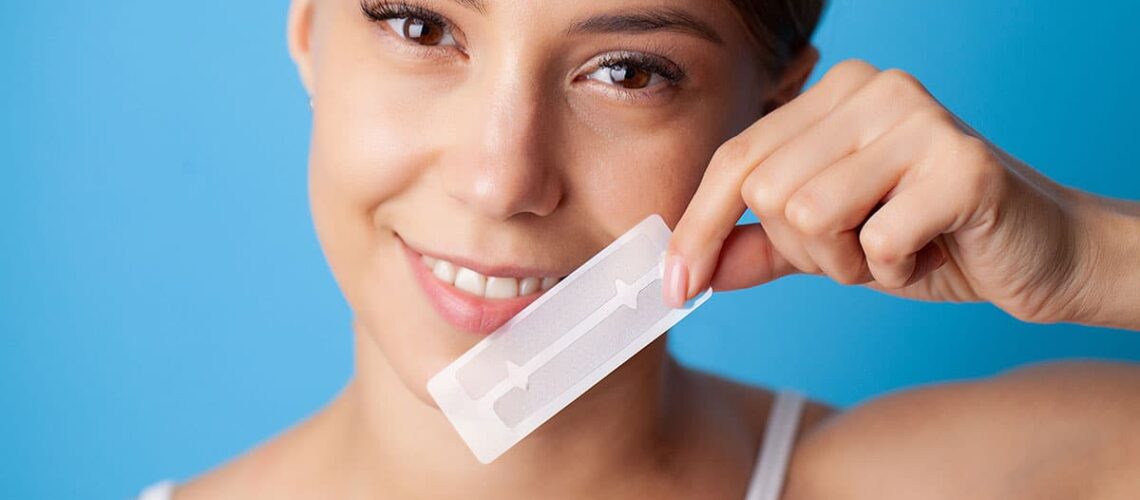
How Whitening Strips Work
Whitening strips brighten teeth using hydrogen peroxide (HP) or carbamide peroxide (CP) — the same whitening agents used in professional dental treatments, but at lower, over-the-counter concentrations (typically 5–10%).
Each flexible strip is coated with a thin gel layer that adheres to the front surface of your teeth. When worn for about 30 minutes, the peroxide breaks down into oxygen molecules that penetrate the outer enamel and oxidize organic pigments, lifting away surface (extrinsic) stains from coffee, tea, red wine, and smoking.
Because the gel stays in close contact with enamel, strips can lighten yellow or brown stains and restore a brighter tone gradually over several days.
However, they don’t change the natural underlying colour of dentin or remove deep (intrinsic) discoloration caused by medication, trauma, or fluorosis.
They also won’t whiten restorations such as crowns, veneers, or fillings – only natural enamel responds to peroxide whitening.
Do Whitening Strips Really Work?
- Yes — whitening strips do work, especially for everyday surface stains.
While the results are not on par with or as fast and safe as a professional whitening treatment from your dentist, multiple clinical studies show that at-home peroxide whitening is both effective and safe when used as directed. - A major review of clinical trials found that at-home bleaching products, including whitening strips, significantly lightened tooth colour compared with no treatment.
- A 2025 Journal of Dentistry Study found that participants using 6% hydrogen peroxide strips achieved visible whitening results after two weeks of daily use.
- A typical at-home whitening timeline has most people noticing subtle changes within 3–5 days, with full results after about 10–14 days of consistent use.
- The most effective whitening comes from in-office treatments, which achieve results in one sitting, rather than over two weeks.

What Affects Your Results
Several factors influence how well whitening strips work:
- Type of Stain: Best for surface (extrinsic) stains; less effective on intrinsic discoloration (from medications or trauma).
- Peroxide Concentration: Higher levels whiten faster but can increase sensitivity. This is a major reason why in-office whitening from your dentist is preferred.
- Consistency: Daily use without skipping days gives more even, noticeable results. This is not a consideration with professional in-office whitening, as the whole whitening treatment is completed in a single appointment.
- Starting Shade: Darker teeth may show a greater visible contrast after whitening.
In short, whitening strips can brighten teeth by one to two shades when used correctly, making them a practical, low-cost option for many people looking to refresh their smile.
Safety and Risks of Whitening Strips
When used as directed, whitening strips are considered safe for most adults. They use peroxide concentrations low enough to avoid long-term enamel damage, and their effects have been reviewed by major dental organizations like the ADA (American Dental Association) and Health Canada.
However, as with any whitening treatment, overuse or improper application can cause short-term side effects.
1. Tooth Sensitivity
- The most common side effect is tooth sensitivity, often described as a mild “zing” or sharp sensation.
- It happens when peroxide temporarily opens tiny pores in the enamel, exposing nerve endings in the dentin.
- Sensitivity usually fades within a few days after finishing treatment.
- Mild sensitivity can be expected with both at-home and in-office whitening.
Tip: Use a desensitizing toothpaste (containing potassium nitrate or fluoride) for 1–2 weeks before and during whitening to reduce discomfort.
2. Gum Irritation
If the whitening gel overlaps your gums, it can cause temporary redness, tingling, or mild burning.
If irritation develops:
- Apply strips carefully — align them just below the gumline and wipe away any excess gel.
- If irritation occurs, skip a day or switch to a “gentle” or low-peroxide formula.
This is one of the safety concerns with at-home whitening kits and something patients don’t need to worry about with professional in-office whitening.
3. Enamel and Soft-Tissue Safety
Research shows whitening strips do not erode enamel or cause permanent damage when used correctly. The peroxide only affects organic stain molecules, not the mineral structure of the tooth.
However, overusing strips, wearing them longer than recommended, or applying multiple treatments too close together can dry out enamel and increase sensitivity.
Stick to the manufacturer’s instructions — “more time” doesn’t mean “more white.”
4. Uneven Whitening
Whitening strips work only on natural enamel and not on crowns, veneers, fillings, or bonding materials.
This can lead to uneven results, especially if you have older restorations in your front teeth.
If you plan to replace or update cosmetic work, whiten your natural teeth first, then match new restorations to your lighter shade.
Dentists often use this approach to ensure a consistent, natural-looking smile.
5. Who Should Avoid Whitening Strips
Skip or delay at-home whitening if you:
- Have active decay, gum disease, cracks, or untreated sensitivity
- Are pregnant or breastfeeding
- Are under 12 years old
- Have orthodontic brackets or attachments
- Have intrinsic stains (like tetracycline or fluorosis) that peroxide strips can’t reach
Your dentist can recommend a safer, customized whitening method that protects your enamel and gums.
6. At-Home vs. In-Office Whitening Safety
While whitening strips are convenient, in-office whitening is safer, faster, and more predictable — especially if you have dental restorations or sensitivity.
Why in-office whitening is better:
- Professional supervision: Dentists can control gel strength, protect your gums, and monitor your comfort throughout treatment.
- Custom isolation: Protective barriers shield gums and lips from peroxide exposure, preventing burns or irritation.
- Stronger yet safer formulas: Professional gels (25–40% hydrogen peroxide) deliver faster, deeper whitening without risking overexposure.
- Personalized approach: Your dentist can identify if whitening is right for you — and adjust treatment for sensitivity, existing fillings, or uneven colour.
- Longer-lasting results: Professional whitening typically brightens teeth by 3–5 shades and lasts longer with proper maintenance.
Think of whitening strips as a gentle, short-term boost, and in-office whitening as the professional-grade solution for deeper, longer-lasting brightness — done safely under expert care.
Whitening strips are safe and effective when used responsibly. Most side effects are temporary and preventable with good technique and a little preparation.
If you experience persistent pain, burning, or sensitivity, pause treatment and check with your dentist before continuing.

At-Home vs. In-Clinic Whitening: Which is better?
There’s no one-size-fits-all way to whiten your teeth. The best method depends on how fast you want results, your level of staining, your sensitivity, and your budget.
Some patients opt for at-home whitening strips because they’re easy and affordable. But for deeper stains or faster, longer-lasting results, in-office whitening under professional supervision is usually the most effective and safest option.
Here’s how each method compares:
Advantages of At-Home Whitening
- Convenient & budget-friendly: Easy to use anytime and available at most stores.
- Gradual brightening: Gentle whitening over several days minimizes post-treatment sensitivity.
- Maintenance-friendly: Ideal for touch-ups between professional sessions.
- Great for beginners: A low-risk way to try whitening before investing in professional care.
Drawbacks of At-Home Whitening
- Less control over coverage: Strips may not fit perfectly, leading to uneven colour, especially near the gumline or between teeth.
- Weaker results: Lower peroxide levels limit how white your teeth can get.
- Slower timeline: It can take two weeks or more to notice full results.
- Can’t treat deep stains: Intrinsic discoloration (like tetracycline or aging) doesn’t respond well to OTC products.
- Risk of user error: Leaving strips on too long or overlapping the gums can cause irritation or sensitivity.
Advantages of In-Clinic Whitening
- Professional supervision: Your dentist protects your gums, lips, and soft tissues, ensuring safety throughout treatment.
- Stronger formulas, faster results: Professional gels (25–40% hydrogen peroxide) penetrate deeper for 3–5 shades of whitening in one visit.
- Even, uniform color: Custom application ensures every tooth lightens evenly — no patchy results.
- Immediate confidence boost: You’ll walk out of the office with a noticeably brighter smile in about an hour.
- Lasts longer: Results can remain visible for 6–12 months with good oral hygiene and periodic touch-ups.
- Custom-tailored approach: Your dentist can adjust gel strength and exposure time to balance comfort and brightness.
Drawbacks of In-Clinic Whitening
- Higher upfront cost: Professional whitening costs more than over-the-counter options — but provides faster, more reliable results.
- Possible short-term sensitivity: The strong peroxide may cause brief tingling or “zingers,” typically managed with fluoride or potassium nitrate gel.
The Bottom Line
- At-home whitening (strips or trays) works well for light surface stains, gradual brightening, and maintenance between dental visits.
- In-office whitening, on the other hand, is the most powerful and precise option — ideal for patients who want noticeable results quickly and safely.
If you’ve tried whitening strips but still feel your teeth look dull or uneven, talk to your dentist about professional whitening. It can safely lift deep stains in a single visit while minimizing risks to enamel and gums.

Expected Results and Maintenance Associated With At-Home Whitening
Whitening strips can noticeably brighten your smile, but the results aren’t permanent.
The whiteness of your teeth and how long they stay that way depend on your habits, diet, and oral care routine.
Here’s what to expect before, during, and after treatment.
How Soon You’ll See Results
- Most people notice a slight improvement after 3–5 days.
- Teeth typically reach peak brightness within 10–14 days of consistent daily use.
- Results are subtle and natural — take-home whitening strips usually lighten teeth by 1–2 shades.
- Darker starting shades often show more visible change.
If you’re looking for a faster or more dramatic transformation — typically 3–5 shades brighter in about an hour — in-office whitening provides that professional-grade jump start.
How Long Do Whitening Results Last?
For most users, whitening results last 3–6 months, depending on daily habits.
The biggest causes of re-staining include coffee, tea, red wine, berries, and tobacco.
With good hygiene and lifestyle care, you can extend your results for much longer.
For comparison:
- At-home strips → 3–6 months average.
- Dentist-supervised trays → up to 9 months with periodic touch-ups.
- In-office whitening → 6–12 months or more with proper care.
How to Maintain Your Whiter Smile
Small, consistent habits make a big difference in keeping your teeth bright:
✅ Brush twice daily with a fluoride or mild whitening toothpaste.
✅ Rinse with water after drinking coffee, wine, or colored beverages.
✅ Floss daily to remove stain-causing plaque between teeth.
✅ Use a straw for dark drinks to reduce surface contact.
✅ Avoid smoking — nicotine is a major cause of yellow stains.
✅ Schedule regular cleanings — your hygienist can polish away new stains before they set.
Touch-Ups and Professional Maintenance
Even with good care, whitening naturally fades over time.
Here’s how to keep your smile bright year-round:
- At-home touch-ups: Reuse whitening strips for 3–5 days every few months.
- Custom trays: If you’ve had professional whitening, your dentist can supply refills of lower-strength gel for safe home touch-ups.
- In-office refresh: A short, dentist-supervised whitening session once or twice a year keeps your smile consistently bright and even.
Professional maintenance visits also allow your dentist to:
- Check for early enamel wear or gum recession.
- Recommend sensitivity management if needed.
- Adjust your whitening schedule safely.
Whitening strips are a simple, effective way to brighten your teeth, but results depend on daily consistency and maintenance.
To preserve your new shade and protect your enamel, combine at-home care with regular dental cleanings and occasional professional touch-ups.
For deeper and longer-lasting brightness as well as safe results, professional treatment and guidance make all the difference.
Canada vs. U.S. Regulations and Safety Labels
Whitening products are available in both the U.S. and Canada, but each country regulates them differently. Understanding these rules can help you choose products that are both safe and effective, and avoid those that may not meet professional standards.
In the United States
- Whitening products are regulated as cosmetics or medical devices, depending on their claims and composition.
- The American Dental Association (ADA) awards the Seal of Acceptance to products that demonstrate proven safety and effectiveness through scientific testing.
- The ADA evaluates factors such as peroxide concentration, enamel safety, soft tissue effects, and long-term outcomes before granting the Seal.
- A few Crest Whitestrips formulations have earned this Seal — meaning they’ve been tested for both tooth whitening efficacy and minimal enamel wear or sensitivity when used as directed.
- When you see the ADA Seal on whitening products, you can be confident they’ve passed independent dental review — not just marketing claims.
What this means for patients:
If you’re buying whitening strips in the U.S., look for the ADA Seal of Acceptance as a sign that the product has been clinically verified and approved by dental experts.
In Canada
- Whitening strips and gels are regulated by Health Canada under the Cosmetic Regulations of the Food and Drugs Act.
- Manufacturers must ensure their products are safe for consumer use and meet labelling, concentration, and safety requirements before being sold.
- Any product containing more than 3% hydrogen peroxide equivalent (or higher carbamide peroxide concentrations) must include safety evidence, such as salivary peroxide studies showing safe exposure levels.
- Products with lower peroxide levels (below 3%) are considered safer for general consumer use but may produce slower or milder results.
- All legal products must display bilingual labelling (English and French), a complete ingredient list, and manufacturer information.
Always check the package for:
- Health Canada compliance or a Natural Product Number (NPN, if applicable)
- Hydrogen peroxide concentration
- Expiration date and manufacturer details
- Clear usage instructions in both languages

Professional vs. Store-Bought Whitening in Canada
Because of peroxide limits, over-the-counter whitening strips in Canada typically contain less peroxide than similar U.S. versions — which means:
- They may whiten more gradually or require longer use.
- Results may plateau at 1–2 shades instead of 3–5 shades seen with professional systems.
- Some “stronger” U.S. products may not be available in Canada due to safety restrictions.
- However, dentists in Canada can legally use higher-concentration peroxide gels under controlled clinical conditions.
- This allows for faster, deeper whitening while ensuring gums and soft tissues are fully protected — a key advantage of in-office whitening.
Why This Matters
Regulation differences are designed to protect patients, but they also mean results vary between over-the-counter and professional treatments.
When in doubt, consult your dentist before using whitening products purchased online or across borders; some may exceed Canadian peroxide limits or lack Health Canada oversight.
Our dental team can recommend products that are both safe for your enamel and compliant with local regulations, ensuring you achieve the best results without unnecessary risk.