Most people want whiter teeth, but not everyone loves the idea of hydrogen peroxide whitening. In the last few years, two big trends have emerged online — PAP+ toothpaste and purple “colour-correcting” toothpaste. Both promise a whiter smile without traditional bleaching, but do they actually work? And are they safe for your enamel?
Let’s break down what the science (and our dentists) really say about these products and how they compare with professional in-office whitening.
Table of Contents
Quick Takeaways
✅ PAP+ (phthalimidoperoxycaproic acid) is a peroxide-free bleaching ingredient that can lighten teeth in early studies, often with less sensitivity than hydrogen peroxide.
✅ Purple toothpaste doesn’t whiten — it neutralizes yellow tones temporarily using colour theory.
✅ In-office professional whitening: dentist-supervised hydrogen peroxide whitening delivers 3–5 shades of brightness in one visit — safely, evenly, and predictably.
✅ For lasting, even results, professional whitening remains the most effective and proven option.
✅ Neither option can match the depth or longevity of professional whitening done by your dentist.
✅ In Canada, both are sold as cosmetic products, but peroxide-free doesn’t always mean risk-free — always check ingredients and labels.
✅ In-office whitening costs more upfront (typically $250–$500 CAD) but offers longer-lasting results (6–12 months or more), while PAP+ and purple toothpaste are lower-cost maintenance products with limited shade change (1–2 shades).
What Is PAP+?
PAP (phthalimidoperoxycaproic acid) is a non-peroxide whitening agent designed to mimic the stain-oxidizing effect of hydrogen peroxide, but through a “radical-free” mechanism.
It works by breaking the chemical bonds of stain molecules on the enamel surface, gently oxidizing discoloration without releasing free radicals that can irritate gums or dentin.
PAP+ is an enhanced version used in popular whitening pastes and strips. It usually contains:
- PAP (the active bleaching compound)
- Hydroxyapatite or calcium ions (to help remineralize enamel)
- Potassium citrate (to reduce sensitivity)
This combination aims to whiten and strengthen enamel at the same time, appealing to people with sensitive teeth.
Early in-vitro studies found that PAP+ could lighten teeth by 1–2 shades after multiple short sessions (6 applications of 10 minutes each), without affecting enamel microhardness, which suggests a gentler alternative for sensitive users.
PAP+ vs. Peroxide Whitening (Professional and At-Home)
| Feature | PAP+ Whitening | Over-the-Counter Strips/Trays | In-Office Whitening (Dentist) |
|---|---|---|---|
|
Active Ingredient |
PAP (peroxide-free) |
Hydrogen or Carbamide Peroxide (5–10%) |
Hydrogen Peroxide (25–40%) |
|
Mechanism |
Breaks stain molecules without free radicals |
Oxidizes stain molecules with oxygen radicals |
Deep oxidation of surface and intrinsic stains |
|
Whitening Depth |
Mild–moderate (surface only) |
Moderate (surface + shallow intrinsic) |
Deep whitening (surface + intrinsic) |
|
Sensitivity Risk |
Low |
Moderate |
Controlled, managed by dentist |
|
Results |
1–2 shades over several weeks |
1–2 shades in ~2 weeks |
3–5 shades in one visit |
|
Best For |
Mild staining, sensitive teeth |
General whitening at home |
Fast, even, long-lasting results |
|
Professional Oversight |
None |
Minimal |
Full supervision and enamel protection |
What Studies Show
- Laboratory studies have found that PAP-based products can whiten enamel 1–2 shades in controlled conditions without reducing enamel hardness.
- Small clinical trials suggest results are comparable to low-dose peroxide gels but slower to appear.
- Long-term data is still limited; peroxide remains the gold standard with the most proven, predictable results.
PAP+ can gently brighten your smile, but professional in-office whitening offers the most dramatic and reliable transformation, with safety protocols in place to protect your gums and enamel.
What Is Purple Toothpaste (Colour-Correcting Whitening)?
Purple or violet toothpastes — sometimes marketed as “colour-correcting” or “V34 technology” — don’t contain any bleaching agents at all.
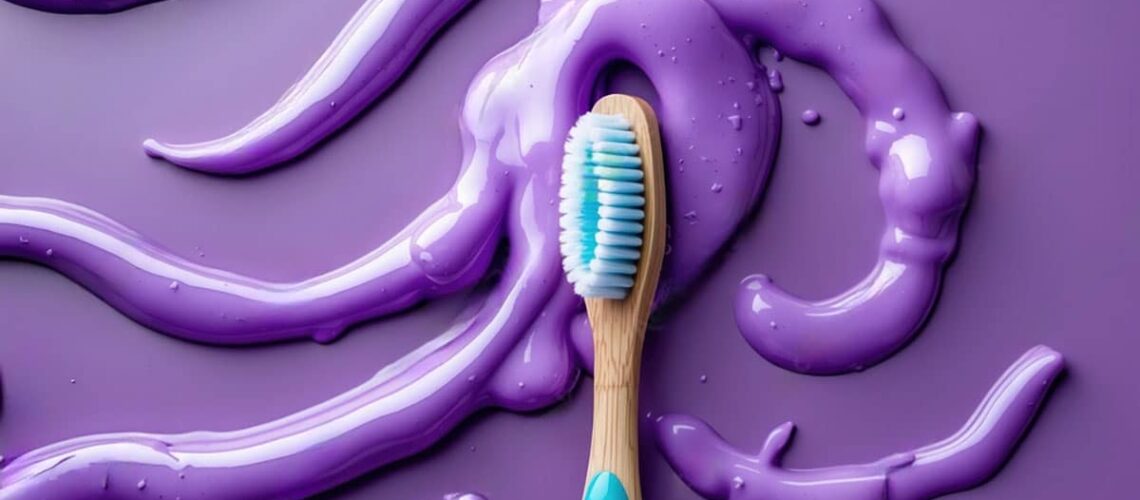
They work using the same principle as colour-correcting makeup or purple shampoo: violet pigments temporarily cancel out yellow tones on the colour wheel, giving teeth a whiter appearance instantly.
When brushed on the teeth, the violet tint creates an optical illusion of brightness, making teeth appear whiter for a short period — usually until your next brushing.
Important Facts
- Purple toothpaste does not chemically whiten or remove stains.
- It only neutralizes surface yellowness temporarily.
- It should not replace your regular fluoride toothpaste, since many colour-correcting pastes lack cavity protection.
- Results fade within hours, so it’s best used before photos, events, or as a quick cosmetic boost.
- Most users notice a visible difference for several hours, especially under bright lighting, but it does not lighten enamel.
How In-Office Whitening Compares
In-office whitening uses professional-strength hydrogen peroxide gels (25–40%), applied under your dentist’s supervision.
Protective barriers cover your gums and lips, ensuring the whitening gel works only where it should — on your enamel.
- Depending on your starting shade and stain type, you can expect:
- 3–5 shades of whitening in one 60–90-minute visit
- Immediate, even results (no patchiness)
- Custom comfort adjustments for sensitivity
- Longer-lasting brightness — often 6–12 months with good habits
Dentists also polish and desensitize teeth after treatment, helping seal the enamel and extend your results.
That’s why professional whitening remains the gold standard for anyone who wants a whiter smile that’s fast, even, and safely achieved.
How PAP+, Purple Toothpaste, and Professional Whitening Compare
| Product / Procedure | Speed | Whitening Effect | Duration | Best For / Ideal Use |
|---|---|---|---|---|
|
Purple Toothpaste |
Immediate (temporary) |
Neutralizes yellow tones for instant brightness |
Hours |
Quick colour boost before photos, events, or between cleanings |
|
PAP+ Toothpaste / Gel |
Days–weeks |
Gentle surface stain removal; minimal sensitivity |
Weeks |
Sensitive teeth, gradual brightening, peroxide-free maintenance |
|
At-Home Peroxide Whitening (Strips or Trays) |
10–14 days |
True bleaching of surface and shallow intrinsic stains |
3–6 months |
Whitening maintenance at home |
|
In-Office Professional Whitening |
Single visit (≈60–90 min) |
Deep bleaching of surface + intrinsic stains |
6–12 months + |
Fast, predictable, longest-lasting professional results |
Safety, Effectiveness, and When to Use Them
Think of PAP+ and purple toothpaste as maintenance tools, not replacements for professional whitening. They can help you keep your smile looking fresh between appointments, but only in-office whitening can deliver a truly luminous, long-lasting change.
PAP-based formulas appear gentle in early research and tend to cause less sensitivity than traditional peroxide, especially when blended with calcium or hydroxyapatite to protect enamel. Still, overuse can lead to temporary dryness or mild gum irritation, so moderation is key.
Purple toothpastes are generally safe, though they can temporarily tint gums or the tongue if not rinsed thoroughly. They’re best used as an occasional cosmetic boost, not as a replacement for your fluoride toothpaste.
Importantly, neither PAP+ nor purple toothpaste can whiten dental restorations such as crowns, veneers, or composite fillings; only natural enamel responds to whitening.
For patients seeking even, durable results, professional in-office whitening remains the safest and most effective solution, with dentist supervision to protect enamel and deliver consistent brightness.
If you’ve recently had in-office whitening, PAP+ can serve as a low-risk maintenance option between professional treatments, helping extend your results for several months.
Which Option is Best for You?
| Option | Best Suited For | Avoid If |
|---|---|---|
|
Purple Toothpaste |
Quick event-ready brightening |
Looking for long-term whitening or deep stain removal |
|
PAP+ Toothpaste / Gel |
Mild stains, sensitive teeth, peroxide intolerance |
Expecting dramatic shade changes or intrinsic stain correction |
|
At-Home Peroxide Whitening (Strips or Trays) |
Moderate stains, general whitening |
Severe sensitivity, gum irritation |
|
In-Office Professional Whitening |
Deep stains, uniform results, special occasions |
None — can be customized for almost anyone under dentist care |
Comparing Results & Cost
| Option | Typical Shade Change | Average Duration | Approx. Cost (CAD) |
|---|---|---|---|
|
Purple Toothpaste |
0 (optical only) |
Hours |
$15–$30 |
|
PAP+ Toothpaste / Gel |
1–2 shades |
Weeks |
$30–$70 |
|
At-Home Peroxide Whitening (Strips or Trays) |
1–2 shades |
3–6 months |
$50–$150 |
|
In-Office Professional Whitening |
3–5 shades |
6–12 months+ |
$250–$500 |
Safety, Effectiveness, and When to Use Them
Think of PAP+ and purple toothpaste as maintenance tools, not replacements for professional whitening. They can help you keep your smile looking fresh between appointments, but only in-office whitening can deliver a truly luminous, long-lasting change.
PAP-based formulas appear gentle in early research and tend to cause less sensitivity than traditional peroxide, especially when blended with calcium or hydroxyapatite to protect enamel. Still, overuse can lead to temporary dryness or mild gum irritation, so moderation is key.
Purple toothpastes are generally safe, though they can temporarily tint gums or the tongue if not rinsed thoroughly. They’re best used as an occasional cosmetic boost, not as a replacement for your fluoride toothpaste.
Importantly, neither PAP+ nor purple toothpaste can whiten dental restorations such as crowns, veneers, or composite fillings; only natural enamel responds to whitening.
For patients seeking even, durable results, professional in-office whitening remains the safest and most effective solution, with dentist supervision to protect enamel and deliver consistent brightness.
If you’ve recently had in-office whitening, PAP+ can serve as a low-risk maintenance option between professional treatments, helping extend your results for several months.
Keep This In Mind
- If a product promises “8+ shades in a week,” be skeptical. That level of whitening is typically achievable only through professional systems.
- Peroxide-free doesn’t mean chemical-free — always check labels for other active compounds or abrasives.
Purple or blue pigments can stain porous enamel if overused, so limit daily use. If you notice increased sensitivity, gum irritation, or uneven results, pause your whitening routine and talk to your dentist.
Your dental team can assess enamel health, remove stains safely, and recommend a whitening plan tailored to your teeth and shade goals.
In most cases, professional whitening at your dental office gives the best blend of safety, speed, and brilliance — while PAP+ or purple toothpaste can help maintain that brightness between visits.
Frequently Asked Questions
Yes — you can use purple toothpaste for a quick cosmetic boost (e.g., before photos) and PAP+ for gradual whitening. Just make sure your routine still includes a regular fluoride toothpaste, and avoid overusing it without guidance.
Many users notice mild changes in 2-4 weeks of consistent use (daily or as directed). Compared to professional whitening, it’s slower, but suitable for maintenance or mild staining.
It may help temporarily reduce the yellow appearance, but because it doesn’t remove stains chemically, users with heavy intrinsic or deep extrinsic stains (from smoking/coffee) will see minimal lasting effect.
Neither will change the colour of these dental restorations. PAP+ is gentler on enamel but won’t lighten restorations. Purple toothpaste is purely cosmetic. If you have visible restorations and want uniform colour, professional whitening or replacing the restoration may be required.
The whitening effect may plateau or gradually fade as staining habits continue (coffee, tea, wine). PAP+ results aren’t permanent, so ongoing maintenance or professional refresh may be needed.
Generally yes, because they don’t use strong bleaching agents. But some contain strong pigments or abrasives, so if your enamel is thin or gums receded, check with your dentist and use gently.
Yes — starting a professional session after PAP+ is fine. In fact, using PAP+ beforehand may help stabilize stain load. Just inform your dentist of your recent product use so they can plan appropriately.
During whitening or colour-correcting treatment, it’s best to minimise staining substances. Coffee, tea, red wine, deeply pigmented foods will reduce or undo the effect.
It varies by product and sensitivity. Many recommend doing a “block” (daily use) and then switching to maintenance (e.g., weekly). Your dentist can tailor the schedule based on enamel health and lifestyle.
Not all do. Some are marketed as “colour-correcting” and lack fluoride or other protective agents. Always check if your toothpaste includes fluoride and consider using a standard fluoride toothpaste in conjunction.
Caution is advised. Teeth are still developing in children/teens, so mild whitening may be OK but best if overseen by a dentist. Purple toothpaste use is likely safer, but still should not replace full oral hygiene.
Yes — because the pigment may be left on soft tissues temporarily. Rinse thoroughly after brushing and avoid foods/drinks that may attract pigment until rinsing is complete.
It depends on goals. If you want modest improvement or have minimal stains, PAP+ may suffice. If you want dramatic, long-lasting results, the higher cost of professional whitening is often justified.
Your dentist can assess based on initial shade, stain type, and enamel status. PAP+ may achieve ~1-2 shade improvements; professional whitening ~3-5 shades or more in one session.
Usually professional whitening is considered cosmetic by insurance and not covered. PAP+ or purple toothpaste are retail purchases and not covered. Always check your plan.
After professional whitening: avoid staining drinks for 24–48h, use desensitizing toothpaste if needed, maintain hygiene and periodic touch-ups. After PAP+ or purple toothpaste: use fluoride toothpaste, avoid heavy-staining foods, and consider regular dentist check-ups to monitor enamel.
Check us out on Facebook and Twitter for daily information about Oral Health from Martindale Dental, or visit our offices in Hamilton and St. Catharines.
Have more questions?
Please contact us for all inquiries or to book an appointment with one of our convenient clinic locations. We look forward to hearing from you.