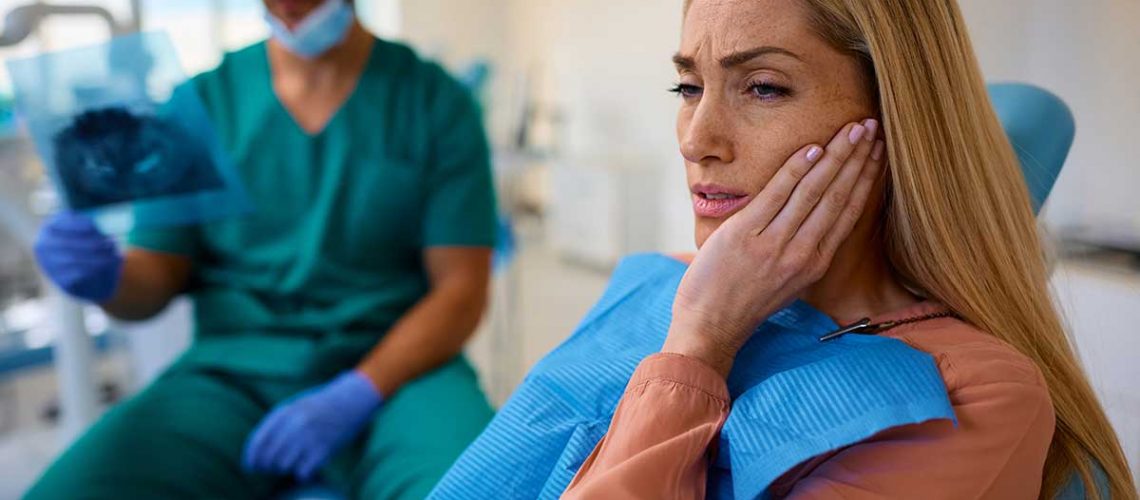
If you have severe tooth pain, a knocked-out or broken tooth, swelling, or bleeding that will not stop, you need to be seen quickly. Call our downtown Hamilton clinic and we will get you in as soon as we can, often the same day.
If it may be life-threatening, call 911
Go to your nearest emergency room or call 911 if you have trouble breathing or swallowing, swelling spreading toward your eye or neck, uncontrolled bleeding, or a serious injury to the face or jaw. A hospital handles these situations that a dental office cannot.
Is this a dental emergency?
Not every dental problem needs same-day care, and a few need a hospital rather than a dentist. Here is a simple way to tell the difference. When you are not sure, call us and we will help you decide.
- Severe or worsening tooth pain
- A knocked-out adult tooth
- Swelling of the gum, face or jaw
- A broken tooth with pain or a sharp edge
- Bleeding that will not stop after gentle pressure
- A dental abscess (pimple on the gum, bad taste, fever)
- A mild ache that comes and goes
- A small chip with no pain
- A lost filling or crown with no pain
- Food stuck between teeth
- A broken or lost retainer or night guard
- Mild, ongoing sensitivity
- Trouble breathing or swallowing
- Swelling spreading to the eye or neck
- Uncontrolled bleeding
- Injury to the head, face or jaw
- High fever with facial swelling
- Jaw pain with chest pain or shortness of breath
What to do right now
These are general first-aid steps to help until you can be seen. They are not a substitute for treatment, so call a dentist as soon as you can.
Knocked-out adult tooth
- Pick it up by the crown (the top), not the root.
- If it is dirty, rinse it gently and do not scrub it or remove any attached tissue.
- If you can, place it back in the socket and bite softly on clean gauze.
- If you cannot, keep it moist in milk (or tucked in your cheek). Do not store it in water.
- See a dentist as fast as possible. Getting it back in within 30 minutes gives the best chance, though a tooth can sometimes still be saved up to an hour or more. Do not try to reinsert a child's baby tooth.
Broken or chipped tooth
- Rinse your mouth with warm water.
- If there is swelling, hold a cold compress to the outside of your cheek.
- Save any pieces.
- Avoid chewing on that side, and call us to be seen.
Severe toothache
- Rinse with warm water and gently floss to remove any trapped food.
- Use a cold compress on the outside of the cheek for swelling.
- Over-the-counter pain relief can help if it is safe for you; follow the label.
- Do not place aspirin directly on the gum, as it can burn the tissue. Call us if the pain is severe or lasts.
Swelling or dental abscess
- Rinse gently with mild salt water.
- Do not try to pop or drain it yourself.
- Call a dentist promptly, since infections can spread.
- If swelling spreads toward your eye or neck, or you have trouble breathing or swallowing, go to the ER or call 911.
Lost filling or crown
- Keep the crown if you still have it.
- A pharmacy dental cement or temporary filling material can protect the tooth for a short time. Do not use household glue.
- Avoid chewing on that side and book an appointment.
Bleeding in the mouth
- Apply firm, steady pressure with clean gauze or a cloth for about 10 to 15 minutes.
- Avoid rinsing hard, spitting, or using a straw, which can restart bleeding.
- If bleeding will not stop, seek urgent care or go to the ER.
When to go to the emergency room instead
A dental office is the right place for most tooth and gum problems, but some symptoms point to something a hospital needs to handle. Go to the nearest emergency department or call 911 if you have:
- Trouble breathing or swallowing
- Swelling that is spreading toward your eye, neck or throat
- Bleeding you cannot control
- A serious injury to the head, face or jaw, or a possible broken jaw
- A high fever alongside facial swelling
- Jaw pain with chest pain, sweating or shortness of breath, which can be a sign of a heart problem
Emergency dental treatments we provide
Once you are in the chair, the goal is simple: relieve your pain and fix the problem. Here is the urgent care we provide in one visit where we can.
Urgent pain relief
We find the cause of severe tooth pain and relieve it quickly, so you are not left waiting it out.
Emergency fillings
For a painful cavity or a filling that has come out, we can place a new filling to protect the tooth and ease the pain.
Emergency tooth extraction
When a tooth cannot be saved and is causing pain or infection, we can remove it and help you plan what comes next.
Emergency root canal
For an infected or abscessed tooth, root canal treatment clears the infection, stops the pain, and saves the tooth.
Abscess and infection care
We treat dental abscesses at the source, drain infection where needed, and can prescribe antibiotics when appropriate.
Broken or knocked-out tooth
We can re-implant and splint a knocked-out tooth, or rebuild a broken one with bonding or a crown.
Chipped or cracked tooth
A chipped or cracked tooth can be smoothed and rebuilt with bonding or a crown to protect it and restore your smile.
Lost crown or filling
We can re-cement a crown that has come off or replace a lost filling before the exposed tooth is damaged further.
Wisdom tooth pain
We assess and treat pain, swelling or infection around wisdom teeth, and arrange removal when it is needed.
Denture repairs
A cracked, broken or loose denture can often be repaired quickly, so you are not left without your teeth.
Emergency care for children
Gentle, prompt care for children's knocked-out teeth, toothaches and injuries, in a calm and reassuring way.
Some complex cases, such as certain surgical extractions, may be referred to a trusted specialist. We will always tell you up front if that applies to you.
What emergency dental care costs, and what is covered
Worrying about cost is one of the main reasons people wait too long. We will always explain what treatment is needed and what it costs before we start, so there are no surprises.
- Canadian Dental Care Plan (CDCP): emergency care such as exams, x-rays, fillings, root canals and extractions falls under the plan's covered services for eligible patients. We accept the CDCP and will verify your coverage. Learn more on our CDCP page.
- ODSP: we accept ODSP and can check what your dental benefit covers. See our ODSP page for details.
- No insurance: you can still be seen. We will go over your options and costs up front before any treatment.
If you are a low-income Hamilton resident with no other dental coverage, the City of Hamilton also runs an emergency dental clinic on the third floor of Jackson Square at 110 King Street West. It is one option among several, and we are happy to help you understand what fits your situation.
Why downtown Hamilton patients choose us
- We are in the heart of downtown, on the main level of Jackson Square Mall at 2 King St W, close to transit and with mall parking.
- Ground-floor, step-free access, next to the farmers market.
- Same-day emergency appointments when you call, and we keep room for urgent problems.
- If English is not your first language, our assistant Sam can help you get started in several languages, including Arabic, Hindi, Punjabi, Persian, Somali, Spanish, French and Chinese.
How to get seen fast
The quickest way to be seen is to call us at 905-393-8501 and describe what is happening. Calling ahead lets our team prepare and get you in sooner. You can also reach us any time through Sam, and our team will follow up as soon as we are open. For anything life-threatening, call 911 or go to the emergency room.
In pain? Call our Hamilton clinic now.
Tell us what is going on and we will get you in as quickly as we can. We accept the CDCP and ODSP, and we will explain any costs before we start.
Emergency dental care in Hamilton, frequently asked questions
Good to know
- This page is general information and is not a substitute for professional care. If your situation may be life-threatening, call 911 or go to the nearest emergency room.
- The first-aid steps follow guidance from the American Dental Association (MouthHealthy), the American Association of Endodontists, and Mayo Clinic. Coverage details reflect the CDCP and Ontario program rules at the time of writing and can change.